



From Some Wilderness Place
Art Gallery of Southwestern Manitoba (Brandon, MB), March 2007
Katharine Mulherin Contemporary Art Projects (Toronto, ON), May 20
From Some Wilderness Place explores the true wilderness of nature and the metaphorical wilderness of the fears, worries and challenges of humans.
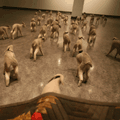
The viewer encounters a hexagon patchwork quilt resembling an abstract rose garden. A herd of animals (small felt sculptures) emerge from beneath the quilt, reminiscent of an exit from Eden, or from Noah's ark. The animals are non-specific Mammals: each is a combination of a deer, a dog, and a hare. As the animals move farther away from the quilt, they alter in form, becoming more twisted, reticent, and more human looking. The herd of animals culminates in a series of dioramas.
The dioramas tell a story inspired by three songs as follows:
The House of the Rising Sun "Tell my baby sister not to do what I have done"
An older sister warns her younger sibling not to go into the woods
In the Pines "I shivered when the cold wind blows"
The younger sister has grown and has not heeded her sister's warning. She is alone in the woods.
Pretty Polly "Left nothing behind but the wild birds to mourn"
A funeral party leaves the woods. The youngest of the party looks back with curiosity, implying that the story will be repeated again.
***
The quilt represents the wilderness that is nature. The hexagon pattern evokes a garden but the shapes also evoke the endless repetition of molecules that make up all things on Earth. The process of making the quilt reflects evolution in nature. The tiny hexagon squares combine to form a large hexagon block, which, combined with many other hexagon blocks, creates a hexagonal quilt. Thus, the quilt can represent both the innocent wilderness of the Garden of Eden and the primordial pool of carbon-based molecules from which life emerged, growing more and more complex as it evolved.
The Mammals also represent an evolution, which is reflected in their demeanor as they transform from confident, focused herding animals to self-involved, self-doubting, twisted and threatened creatures. Making their way across the floor, the Mammals bridge the physical wilderness of nature and the metaphorical wilderness of the human mind. They become the shadows in the dark that are our secret desires and our nighttime fears.
The woods in the diorama story represent the metaphorical wilderness. In the story, told through the excerpts of the three songs, a young girl disregards counsel and is lead astray by a lover who murders her in the woods. This story is a metaphor for the death of innocence: The girl must enter a wilderness to face her questions, fears and desires. The funeral in the final scene mourns her lost innocence.
In the many folk songs in which an innocent girl is either murdered or betrayed by a lover, the act of violence or betrayal usually takes place in a forest or in some other wild and desolate place. The wilderness of the setting reflects and amplifies the inner wilderness of the girl’s experience. Similarily, the presence of the hexagon pattern in the dioramas repeat the pattern in the quilt and remind us that as we navigate our own inner wilderness, we are never far from the true wilderness of our origins.